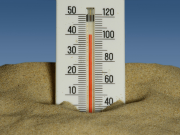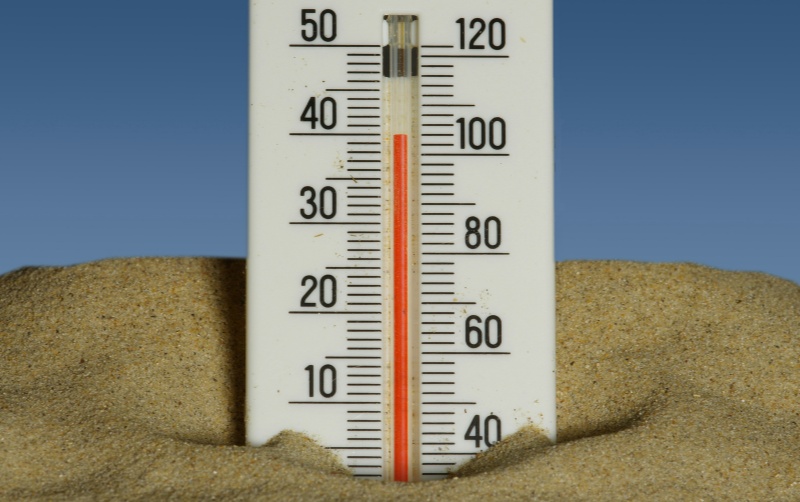
The UK isn’t exactly renowned for its hot summers, but with global efforts to curb climate change falling short, the British weather is becoming decidedly less British as the years go by.
In response to the recent heat health alert, the Health and Safety Executive (HSE) has called on employers to step up hot weather protections for workers, but what does this look like in practice?
In this guide, we offer advice on reducing the risk of heat stress in the workplace, discussing the trajectory of UK weather and how businesses can prepare for future heat waves.
Employee’s rights during a heatwave - and employer’s responsibilities
While there are no specific UK heatwave work laws, employees have a right to a safe work environment, and employers are required to protect workers from hazards - including extreme heat.
The HSE requires employers to guarantee a ‘reasonable indoor temperature’, or, for outdoor work, employers must ‘provide protection from adverse weather.’
Without an enforced temperature threshold above which work must stop, employers need to take the initiative and do whatever possible to assess risk and put suitable hot weather protections in place.
What does ‘hot weather protections’ mean in practice?
The nature of viable hot weather protections differs based on the type of work and the work environment, but below there are several practical and HSE-recommended options to consider:
- Providing free and access to drinking water via water dispensers
- Installing air conditioning
- Checking air conditioning is fully functional ahead of heatwaves
- Informing employees about the symptoms of heat stress and what to do if someone is affected
- Allow flexible working so employees can work during cooler times of day
- Allow the wearing of lighter clothing - where possible
- Providing weather appropriate PPE - where needed
- Reminding employees to remove PPE during resting periods
- Ensure windows are working - and can be opened or closed to prevent heat build-up
- Use blinds or reflective films on windows to block and reflect sunlight and heat
- Adjust layout so workstations are not in direct sunlight
- Insulate exposed pipes that heat up during the workday
- Allowing more breaks - and ensuring there are shaded areas to rest
Beyond this, employers should take care to really listen to employees. If your team is reporting difficulties, you’ll need to intervene to improve working conditions.
The role of hydration in combating heat stress at work
Hydration plays a key role in keeping us cool in hot weather, particularly at work where physical effort, PPE and long shifts can increase fluid loss.
When employees become even mildly dehydrated, their ability to regulate body temperature drops1, significantly increasing the risk of heat stress, fatigue and reduced concentration.
Related - What dehydration does to your body
Employers should make sure cool drinking water is freely available, encourage regular water breaks and remind staff to drink little and often throughout the day.
For most work environments, the simplest and most effective way to achieve this is through installing appropriate water dispensers where employees can easily reach them during work hours.
At CWS, we stock a broad range of outdoor and indoor water dispensers to suit a variety unique working environments and sectors, including:
- Offices
- Factories & warehouses
- Schools & universities
- Leisure, gym & sports
- Hospitality & catering
- Healthcare facilities
- Other high traffic environments
Our hydration solutions are available to rent or purchase, and we offer truly flexible servicing and maintenance plans to ensure the highest level of service and satisfaction. Learn more about our hassle-free approach to hydration.
The direction of UK weather - should businesses be worried?
According to the Met Office scientists, temperatures up to 45°C are ‘plausible’ in England by 20562, and climate change is increasing the frequency of extreme weather events.
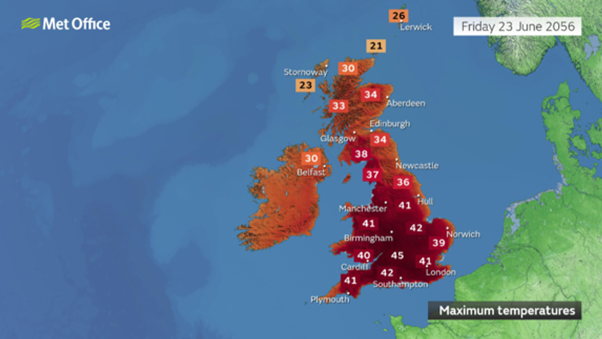
Source: Met Office
Every heatwave like the one just passed is a major health hazard in general, but it poses both safety and operational challenges for businesses too.
The biggest concern is of course that hot working conditions can harm employees. Without protections in place, heat stress is a significant risk factor. Over one-third of all people who frequently work in hot conditions experience heat stress2, and in severe cases, it may progress to heat exhaustion or even heat stroke.
While secondary to employee safety, heat-related productivity issues are well researched and will become more prominent across UK businesses as temperatures continue to rise.
Lead climate economist at Oxford Economics, Robert Marks, suggests that temperatures in the high 30s and low 40s will “likely lead to substantial productivity losses”3.
Should businesses be worried? - Yes, particularly those that involve outdoor work. But indoor workers are also at risk. Businesses that do have control over the work environment should be taking appropriate steps to keep their employees cool and hydrated throughout the workday.
At what temperature does heat stress occur?
There is no single temperature at which heat stress becomes a risk factor, but it’s known that between core temperatures of 38°C to 40°C, the chances of someone experiencing heat stress or heat exhaustion rise5.
Beyond the 40°C threshold, heat stroke becomes a possibility.
At any stage of heat-related illness, it’s essential to cool an employee down quickly through hydration and rest in a cool, shaded area.
Protect your workers with a Cactus Water System
Water access is one of the most important parts of hot weather protections in the workplace, and CWS makes it easy and cost efficient to ensure your team has easy access to clean, great-tasting water.
Wherever your work happens, if you need advice on upgrading existing water dispensers or installing new units, we’re always happy to help. Please contact us today, and we’ll help you find the ideal hydration solution for your business and employee needs.
Citations
- Hydration effects on temperature regulation - pubmed
- UK could see 45 by 2056, scientists reflect on 1976 heatwave anniversary - Met Office
- Workplace heat stress - WHO
- Too hot to work: why extreme heat is a threat to Europe’s productivity - The Guardian
- Heat exhaustion: symptoms and treatment - Cleveland Clinic